
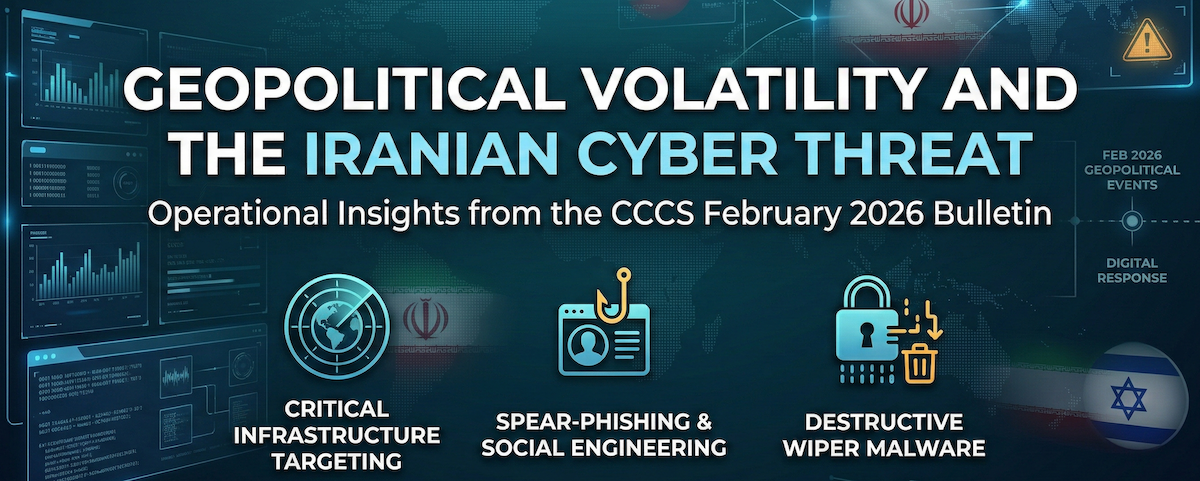
The intersection of kinetic warfare and keyboard-driven operations has never been more visible. Following the joint U.S. and Israeli military strikes against Iranian nuclear and military assets on February 28, 2026, the Canadian Centre for Cyber Security (CCCS) has issued a critical threat bulletin.
At Critical Path Security, we’ve always maintained that layered defence isn't a buzzword—it’s a survival requirement. As geopolitical tensions boil over into the digital domain, Iranian state-sponsored actors are pivoting from standard espionage to disruptive and destructive operations.
Here is what the current threat landscape looks like and, more importantly, what your team should be doing about it.
The Threat Profile: Beyond Simple Phishing
The CCCS identifies four primary ways Iran is likely to respond. While information operations and harassment are common, the real risk to our clients lies in the targeting of critical infrastructure and poorly secured IoT/ICS devices.
Iranian actors (including IRGC-affiliated groups) typically favor three methodologies:
-
Exploitation of Known Vulnerabilities: They aren’t always looking for zero-days. They are scanning for internet-exposed systems that are unpatched or use default credentials.
-
Sophisticated Social Engineering: Expect highly targeted spear-phishing campaigns that leverage professional personas on LinkedIn or other platforms to infiltrate aerospace, energy, and defense sectors.
-
Destructive Malware: We are seeing an uptick in "wiper" malware and ransomware-style encryption used not for financial gain, but for pure operational disruption.
Why This Matters for North American Organizations
Even if you aren’t a direct military contractor, you are in the blast radius. Pro-Iran hacktivists often target "opportunistic" entities in allied nations—including Canada and the U.S.—to demonstrate reach. This includes DDoS attacks against financial institutions and the manipulation of industrial control systems (PLCs) in water and energy sectors.
High-Fidelity Behaviour Alerts
These queries focus on the "ransomware-as-cover" and "wiper" tactics currently seen in the 2026 landscape.
1. Detecting Persistent Tunneling (The "Kitten" Profile)
Iranian actors like Pioneer Kitten frequently use open-source tunneling tools to bypass firewalls and maintain a foothold. This query flags the execution of common tunneling binaries or commands.
Query Logic: Process.NameDescriptor in ("ngrok", "frpc", "cloudflared", "plink") OR Process.CommandLine Contains any (" -tunnel ", " -remote ", " -proto ", " -server ")
What it catches: Unauthorized remote access tools that allow an attacker to tunnel RDP or SSH traffic through your perimeter without a traditional VPN.
2. Monitoring for Destructive "Wiper" Activity
Unlike standard ransomware that leaves a decryption path, Iranian groups often use wipers like Apostle or Meteor to destroy data. This query looks for the characteristic "pre-wipe" commands used to disable recovery options.
Query Logic: Process.NameDescriptor == "bcdedit.exe" AND Process.CommandLine Contains any ("/set {default} recoveryenabled No", "deletevalue {default} safeboot", "ignoreallfailures")
What it catches: Attempts to sabotage the Windows boot process and disable recovery environments, ensuring that once the wiper triggers, the system cannot be easily restored.
3. Identifying VPN Edge Exploitation (Post-Exploit Behavior)
Following the exploitation of gateway vulnerabilities (like the Ivanti or Palo Alto CVEs mentioned in the 2026 bulletin), attackers often deploy web shells. This query monitors for suspicious processes being spawned by your web server or VPN management processes.
Query Logic: Parent.Process.NameDescriptor in ("w3wp.exe", "httpd.exe", "nginx.exe") AND Process.NameDescriptor in ("cmd.exe", "powershell.exe", "whoami.exe", "net.exe", "nltest.exe")
What it catches: "Living-off-the-Land" commands being run from a web service, which is a classic indicator that an attacker has gained a foothold via a web shell or unpatched edge vulnerability.
4. Credential Theft via Registry Hives
Groups like MuddyWater frequently export the Windows Registry to harvest credentials offline. This is a quieter alternative to dumping LSASS.
Query Logic: Process.NameDescriptor == "reg.exe" AND Process.CommandLine Contains "save" AND Process.CommandLine Contains any ("SAM", "SECURITY", "SYSTEM")
What it catches: Attempts to copy the registry hives that store local password hashes and secrets.
5. Suspicious DLL Sideloading in System Directories
Iranian APTs often use DLL sideloading to hide their custom backdoors inside legitimate directories like PerfLogs or C:\Windows\Temp.
Query Logic: File.Path Contains any ("C:\PerfLogs", "C:\Users\Public") AND File.Extension == ".dll" AND Process.NameDescriptor not in ("TrustedInstaller.exe", "MsMpEng.exe")
What it catches: New, unauthorized DLLs appearing in directories commonly used for "hidden-in-plain-sight" persistence.
Actionable Intelligence: Hardening Your Path
In an environment where attackers move faster than automated tools can sometimes keep up with, human-led analysis and proactive hardening are your best bets. We recommend the following immediate actions:
-
Audit Your Edge Devices: Iranian actors are notorious for exploiting VPN vulnerabilities. If your gateways aren't patched and MFA isn't enforced across the board, you are leaving the front door unlocked.
-
Disable Unnecessary Services: If a device doesn't need to be internet-facing (especially PLCs or internal management interfaces), pull it back.
-
Review Social Media Hygiene: Train your high-value targets (executives and engineers) on the risks of professional social engineering. Iranian groups excel at building long-term rapport before sending a malicious payload.
-
Verify Your Backups: Destructive wiper malware makes "offline" and "immutable" backups the only true safety net. Test your restoration process today—not during an incident.
The Critical Path Perspective
At Critical Path Security, we don't just react to alerts; we provide the context that turns signals into strategy. Geopolitical events like those in February 2026 serve as a reminder that the "critical path" of your business operations often relies on systems you might currently consider secondary.
If you are concerned about your organization’s exposure to state-sponsored activity or need a comprehensive Cybersecurity Gap Assessment, our team is ready to help.
Stay Vigilant. Stay Hardened.
Resources for Defenders:
-
Canadian Centre for Cyber Security Bulletin (Feb 2026)
-
Léargas Threat Intelligence: Active Iranian TTPs
-
CISA Guidance on Hardening Communications Infrastructure